
CNC Prototyping Services
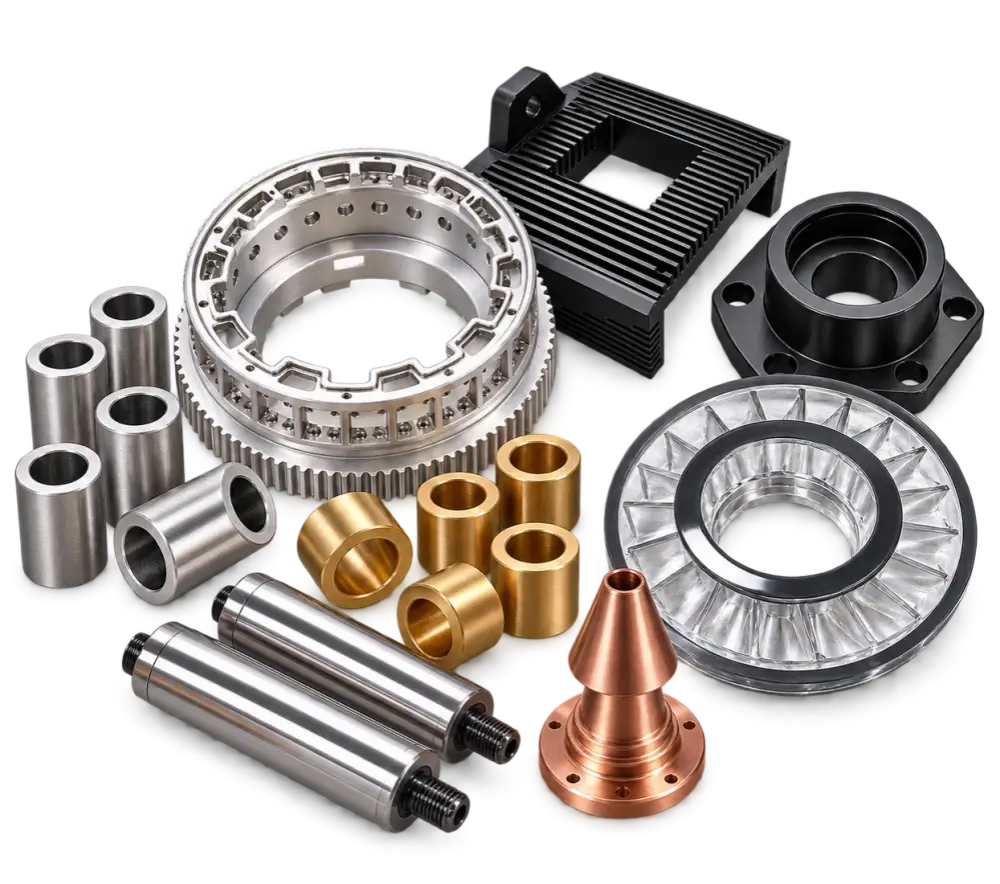
Precision CNC-machined prototype parts in metal or engineering plastic
- Prototype quantities starting from 1 piece, no MOQ
- 5- 8 days fast turnaround for prototypes
- Parts machined to your drawings
- Inspection and finishing options for functional prototypes
Why choose CNC machining for prototyping?
Before committing to a larger production run, CNC machining lets you evaluate the assembly and function of the design.
Structural Performance
Check the actual structure, and also test the part of the load conditions on the specified material in its intended use environment.
Assembly
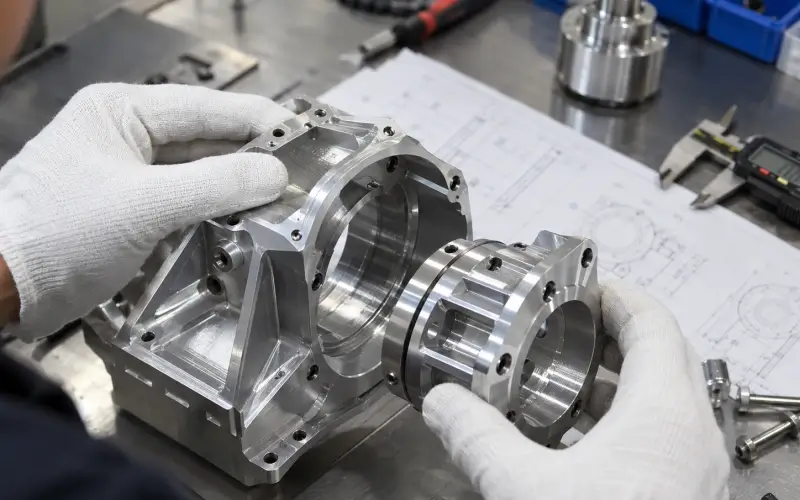
Check mating faces, bearing seats, hole positions, and clearances against adjoining components. Ensure the design is reasonable.
Manufacturability
Review actual tolerance specifications of the drawing, difficult features, or setup challenges before ordering more parts.
Appearance and Function
Check the part for surface finish. Or show the working prototype sample to the end customers before mass production .
CNC Prototypes vs. 3D Printing Prototypes
Choose the process based on what your prototype needs to prove. CNC can mill a wide range of materials and make the machined part match the material’s performance. 3D printing can be effective for early form checks, complex shapes, or geometries that are difficult to CNC machine.
| Factor | CNC machining | 3D printing (FDM / SLA / SLS) |
|---|---|---|
| Material | Parts machined from the select raw material | Available materials and properties depend on the printing process. |
| Mechanical properties | Same as the raw material and condition | Layer delamination in the appearance, alternative material, similar performance |
| Tolerances | ±0.005-0.05 mm on precision features | ±0.05-0.5 mm depending on technology and geometry |
| Surface finish | Anodizing, painting, plating, polished, brush | Painting, as printing |
| Internal features | Tool has to reach them, limited by geometry | Support complex internal geometries, no tool access limitation |
| Typical use | Fit checks and functional tests requiring specified stock material or machined features | Concept models, form and geometry checks |
| Lead time | 5 - 8 days | 3 - 5 days |
| Cost drivers | Programming, setups, material, machining time, inspection, and setup costs can be shared across identical parts. Usually is expensive for samples | Build time, material, supports and post-processing; often economical for simple one-off form checks |
CNC prototype parts Case Studies
Explore real CNC prototyping projects across different materials, parts, and applications.
01
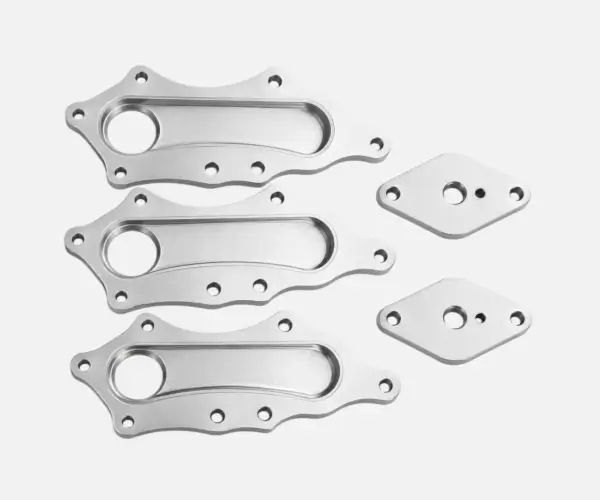
Aluminum Bracket Design Variants
- Material: Aluminum 6061-T6
- Process: 3-axis CNC machining
- Surface finish: Clear anodizing with bead blasting
- Location: Netherlands
One of our customers, who develops a family of engine accessory brackets, required only a few parts for comparative testing and fit checks. The challenge was efficient management of several distinct part programs with uniform finish quality. We programmed each design variant from the same datum reference to have the same measurement results across the whole family. All parts were bead blasted and naturally anodized in a single batch after machining to have a uniform appearance.
02
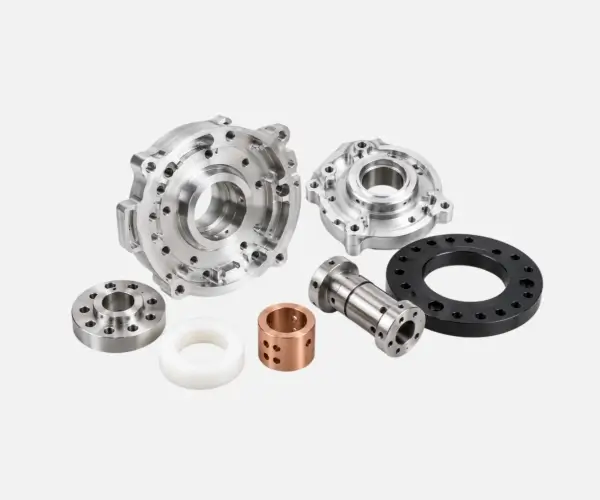
Robot joint assembly
- Material: Multiple materials
- Process: 3-4 axis CNC machining, CNC lathe
- Surface finish: Multi finishes
- Location: Italy
The customer ordered one complete assembly set. Parts are made of aluminum, stainless steel, copper, and POM to confirm and check if fit and function before going into small-batch production. We managed milling and turning operations for all materials, checked all parts after finished the production, and shipped the whole set at once. The customer confirmed assembly fit and function and started small-batch production.
03
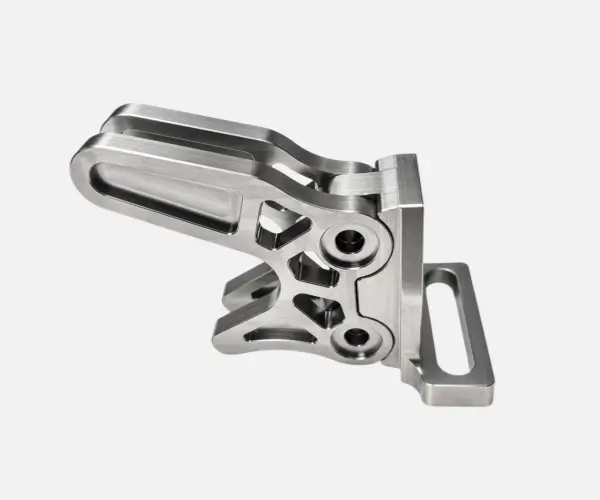
Hinge parts
- Material: 17-4 PH stainless steel
- Process: 5-axis CNC machining
- Surface finish: Heat treatment
- Location: USA
The hinge geometry, compound angles, intersecting bores that should be coaxial, and mating faces at non-orthogonal positions would require five or more setups on a 3-axis CNC. Each additional setup means datum transfer error. The part’s tolerance requirements are tight, the accumulated setup errors are a serious risk. On the 5-axis CNC, we machined the same part in two setups.
Other CNC Machining Services
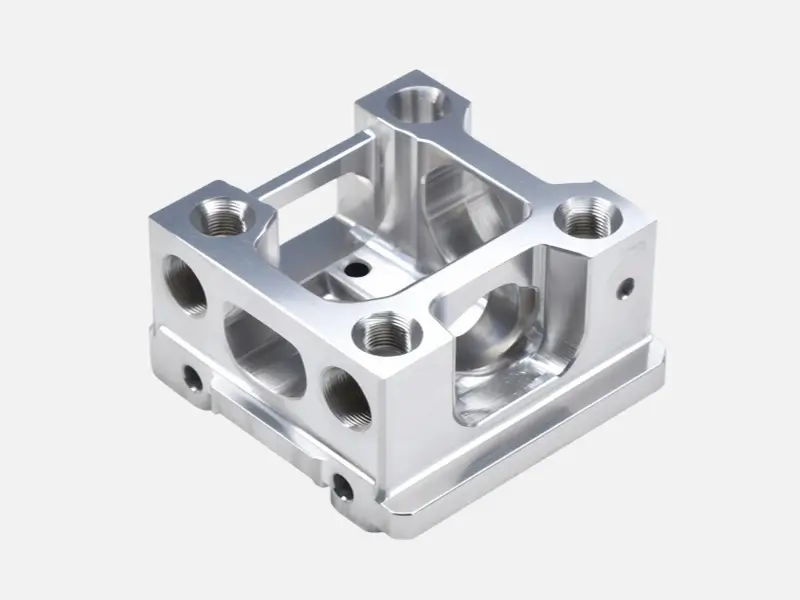
We also offer low-volume production, plastic CNC machining, and our full range of CNC services to further support your project.


CNC Prototyping FAQs
What is the difference between CNC prototyping and 3D printing?
CNC machining mills parts from real materials aluminum, stainless steel, ABS, PEEK, etc. which are the same as production. Some 3D printing materials, such as ABS-like resins, simulate selected properties of the target material but do not have the same composition or full mechanical and thermal performance. CNC machining is well-suited when your tests require a specific material grade and condition.
How quickly can you deliver prototype samples?
Lead time is 5-8 working days for regular material grades: aluminum, carbon steel, stainless steel, POM, PC, ABS. Urgent projects can be shorter to 2-3 days. If special grade material or complex parts, it may increase the time. Post-processing (anodizing, plating, passivation) takes 3-5 days after machining. We’ll confirm the lead time with your quote sheet.
What is the minimum order quantity?
MOQ is 1 piece. You can order a single prototype, a set, or a functional test. However, per-part cost decreases with an increase in quantity due to cost reduction.
Can the prototype parts be used for functional testing?
Yes. CNC-machined prototypes can be used to evaluate assembly fit and performance under load, vibration, or other intended operating conditions. CNC machining also supports small initial batches for market testing, allowing you to gather customer feedback before committing to larger production volumes or production tooling.
How does CNC prototyping reduce production risk?
Prototyping can be help find design errors or issues in the early stages. The risk is that the prototype costs you one machined part. The same flaw found after injection molding or die-casting tool construction costs tooling modification or a new tool. Prototyping also confirms the design drawing completeness.
Can prototype parts have the same surface finish as production parts?
Yes. Prototype parts can use the same surface finishes as production parts, including as-machined, anodized, painted, bead-blasted, powder-coated, passivated, and polished finishes. Just let us know your requirements, and we’ll coordinate the appropriate post-processing.
Start Your CNC Prototyping Project with Our Team
Upload your CAD files, get a free and fast quote today