
Plastic ABS Prototypes in CNC Machining, Vacuum Casting, and Injection Molding Compared
When you design a project with plastic parts, it is common to say that the final mass production goods will be made of ABS, so I also want the prototype to be ABS. Using the same material from prototype to batch, it not only helps you validate the structure of the design, but also the touch feeling of the parts, their behavior, and performance, etc. However, “ABS prototype” has different meanings in manufacturing:
- CNC-machined ABS
- vacuum-cast “ABS-like” resin
- injection-moulded ABS
Each processing method has its own advantages and disadvantages. The best choice depends on your project quantity, deadline, budget, and how close you need to be to the batch production.
Why do engineers like ABS for prototypes?
ABS (Acrylonitrile Butadiene Styrene) plastic is widely used across many everyday industries. In consumer electronics as laptop shells, TV housings, game controllers, and home application bodies. In the automotive industry, many of the interior trim, dashboards, pillar covers, and some exterior grills, spoilers, and bumper parts are made from ABS. In industrial manufacturing, including machine housings, control panels, enclosures, and cable management parts. ABS has good impact resistance, lighter, economic, dimensional stability, etc features.
For prototyping, plastic ABS has a combination of properties that make it very attractive:
- Good impact resistance: tougher than many commodity plastics
- Colorful surface finish: Easy to paint, texture, chrome, and water transfer
- Reasonable cost: Raw material is not too expensive, easy to source, and purchase
- Lightweight: Around half the weight of metal aluminum
Due to these reasons. If your final parts will be ABS, making the prototype in ABS is best chosen.
CNC-machined ABS prototypes
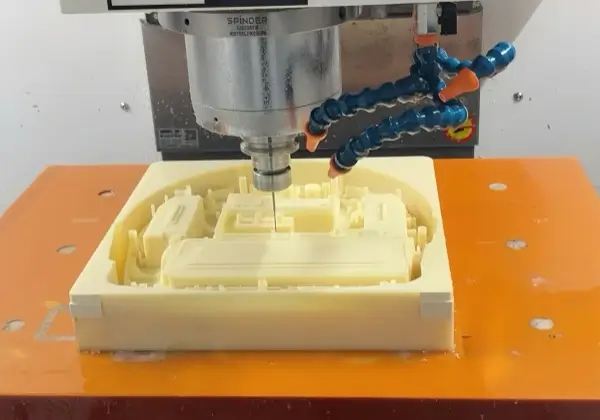
For many R&D and mechanical engineering teams, CNC machining is the most practical idea for high-quality ABS prototypes. In this process, the part of the drawing is cut from a solid raw material of ABS block on 3-axis, 4-axis, or 5-axis CNC machines. This can keep the ABS material properties, show details, and have a good dimensional accuracy.
Advantages of CNC-machined ABS
- True material behaviour: milling with really ABS, the stiffness, the toughness, and the temperature performance are very close to the final part.
- High appearance: after parts are machined, they can be polished, textured, painted, or silk-printed to look more beautiful. Visible faces and good details are able to meet the high standard.
- Good tolerances: around ±0.05 mm on many features are realistic, this is can often meet the demand of many functional and structure prototype samples testing.
- Cost-effective and thin timeline: especially for a large overall size only needs a few sample pieces. CNC machining ABS doesn’t need to open molds like injection molding. Directly milling block material can get the shapes of the parts. And many parts take 7–12 days from final CAD to shipment is regular.
CNC-machined ABS is an excellent option when you need prototype for customers, investors or trade shows. Also functional parts for assembly testing. Or 1 piece to low-volume a few dozen parts. In additional, for the design you may are still refining the modify.
Vacuum-cast “ABS-like” prototypes
Sometimes you may need more pieces than just one or two parts, but you don’t want to invest in injection-molding tools. This is where vacuum casting with ABS-like resin becomes very attractive.
In vacuum casting processing, it typically looks like this: CNC machine or 3D printing a master prototype of the part. Building a silicone mould based on the master. And then mix and pour a two-component polyurethane resin into the mould under vacuum. Cure, demould, and finish the cast parts.
Because this kind of resin’s mechanical and visual behaviour is similar to ABS, we usually call it “ABS-like” rather than ABS. Chemically it is not the same, but it for prototyping purposes is enough.
Advantages of ABS-like vacuum casting
- Ideal for small batch production: you can typically cast 10–20 parts after a silicone mould is made. With a much lower cost than an injection tool.
- Good appearance: Parts can be colored in the resin, or painting after casting. With the good finishing, they can look very close to injection moulded ABS parts. It’s suitable for design reviews and customer demos.
- Reasonable mechanical performance: ABS-like resins are stiff and tough enough for many housings, covers and non-critical structural parts. They are often used for functional testing and pilot runs.
- Easier for design modification: Making a new master and silicone mould is still lot of cheaper and faster than modifying steel tooling.
Injection-moulded ABS prototypes
Injection moulding is the standard and mature process for high-volume plastic parts. Molten ABS is injected into a steel or tool steel mold, cooled, and then ejected to get the parts. For mass production, the unit part cost is lower than CNC machining or silicone molding.
For prototypes, injection moulding has advantages and disadvantages. The prototype samples for testing are exactly the same as those you will use in volume production. They are produced from the same mold. In actuality, most of injection molds will produce a few trial mold samples for customers to confirm before mass. Another advantage is a very low unit piece cost once the tool is paid. A few dollars a piece, or 1 or 2 dollars, some even a few cents.
One of the disadvantages is the high tooling cost. Many manufacturers require payment of the full tool cost before production, which is a big investment. And with a long lead time of 30 days, or even 50 days to complete the mold. On the other hand, if the design needs to change is expensive. Because a small detail change may require tool rework or a new tool.
Therefore, injection-moulded ABS prototypes aren’t the first choice for the single prototype, small batches (1–20 pcs), and uncertain design in the early stage. It will become attractive when you confirm the design is the same as the final batch of manufactured parts.
Need help with ABS plastic prototypes for your project?
If you’re still not sure whether machining ABS plastic, vacuum casting, or injection molding is the best fit for your parts. Just share with us your 3D files, tolerances, and quantities, etc information. We’ll review the details carefully and recommend the most efficient and cost-effective option for your stage of development.