
A Guide for CNC Machining Custom Manufacturing
Computer Numerical Control (CNC) machining is a quick manufacturing process aided by a computerized software program. The technology is to turn a 3D model design into a real physical part. It’s ideal for prototypes and small batch production for quantity 1 to 1000 pieces. This blog introduces the types of materials of CNC machining parts, the tolerances, and how to choose the material, etc.
Metal Materials for CNC Machining
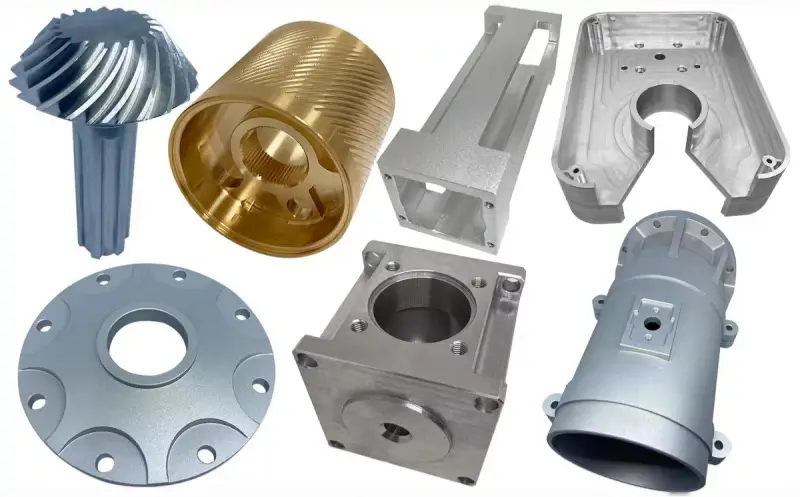
CNC metal milling a solid stock into precise parts. Set up a programmer in the computer to drive the tool, then the CNC machine does the heavy work. CNC handles complex shapes and complex designs with small dimensions and a thin tolerance of the part. It’s very fast for prototype making and stable for small-batch runs. It might be a vehicle part or an electronic consumer component. Including industrial manufacturing, home appliances, automotives, digital communications, and medical equipment industrials.
CNC deals with all kinds of metal materials, such as aluminum, stainless steel, steel, titanium, copper, iron, brass, magnesium, etc in common. How to choose the right metal material for do prototype is important. Not only think about strength, weight, corrosion resistance, finish, etc. But also electrical needs, check machinability, and cost, etc, factors. Here is some common metal materials and their features:
| Material (typical grades) | Strength / Weight | Corrosion | Machinability | Notes & typical uses |
|---|---|---|---|---|
| Aluminum 6061-T6 | Medium / very light | Good with anodize | Easy | General brackets, housings, fixtures; great all-round choice for prototypes |
| Aluminum 7075-T6 | High / very light | Fair; anodize recommended | Medium | Higher strength, better threads; aerospace-style parts; slightly harder to cut than 6061 |
| Aluminum 6082 | Medium-high / light | Good with anodize | Easy | EU alternative to 6061; structural parts |
| Carbon steel | Medium / heavy | Low (needs finish) | Easy-medium | Economical, ductile; black oxide or zinc after machining |
| Alloy steel | High / heavy | Low-medium | Medium-hard | Wear-resistant, stable; tooling, spindles; rigid setup required |
| Stainless steel 304 | Medium / heavy | Good | Medium | Food/consumer parts; clean cosmetic finish |
| Stainless steel 316 | Medium / heavy | Very good (marine) | Medium-hard | Better chloride resistance; outdoor, medical hardware |
| Brass | Medium / medium | Good (indoor) | Very easy | Tight tolerances, sharp edges; fittings, aesthetic parts |
| Copper | Medium / heavy | Good | Medium-hard (gummy) | High conductivity; thermal/electrical parts; sharp tools, coolant control |
| Titanium Ti-6Al-4V | Very high / light | Good | Hard | Excellent strength-to-weight; medical/aero; slow cutting, heat management needed |
| Magnesium AZ31 | Low-med / ultra-light | Low | Easy (with care) | Very fast to cut but flammable chips—use proper safety and chip control |
If you still don’t have an idea what kind of metal should be pick, the aluminum 6061 is usually the best value. Stainless steel has higher strength increases cycle time, and tool wear. The brass raw material cost is expensive. You can change to the higher-performance alloy after you validate the design and tolerances.
Plastics Materials for CNC Machining
Besides metal materials, plastics material is another big series for CNC machining parts. They can be cut faster, lighter, and more colorful of the raw materials. However, plastics also often heat, absorb moisture, and deform, etc issue after CNC milling. In Xinprototype shop, thanks to using good sharp tools, light chip loads, steady chip evacuation, and careful fixturing to fix the issues. In the same time, set up with a higher spindle speed, reasonable moderate feed, and air blast the debris. The high efficiency of the machine produces the product with the exact dimensions mentioned in the software program. It has the power to model a solid piece of plastic into a required design with a fast-speed CNC machine followed by a digital design file. Ultimately, you get the final shape of the design within a 30 minutes or few minutes, even sometimes seconds.
ABS is a popular and common plastic in CNC milling. It’s lighter, the raw material is not expensive, and CNC machining is easy. Also good for surface finishes, such as painting, plating, chrome, etc. Ideal for prototype and small batch production for housing or components.
POM has the best machinability for engineering plastics. It has low friction, low moisture uptake, and tight dimensional stability features. Good for gears, sliders, and jig parts.
For transparent parts, PMMA (acrylic) and PC (polycarbonate) give the highest optical clarity but are brittle. Using sharp tools to avoid sudden plunges is important. Can use generous fillets to prevent cracking. Edges and body can be sanded to get a lens-like finish.
PEEK and PTFE have outstanding performance, but require rigid fixturing, sharp carbide, conservative step-downs, and heat control. Because they are very slippery and “gummy”.
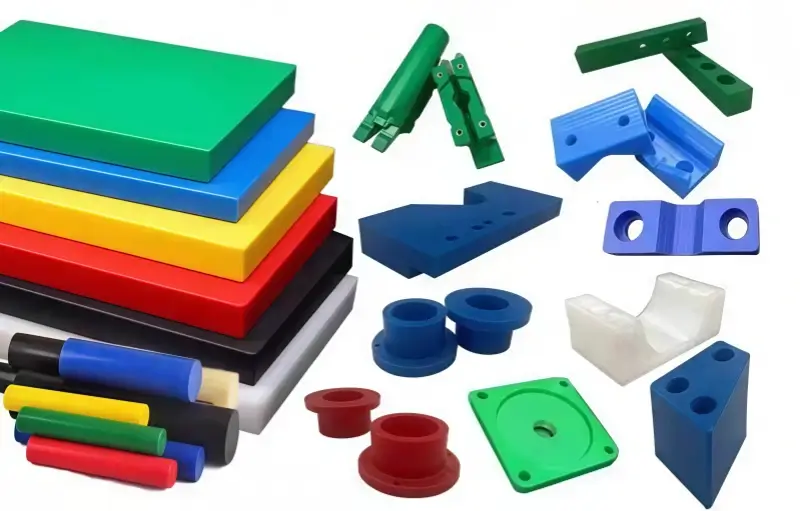
Below is a list of plastic materials’ characteristics
| Material (typical grade) | Machinability | Continuous use temp °C* | Dimensional stability | Suggested tolerance (general) |
|---|---|---|---|---|
| ABS | Easy | 80–90 | Medium | ±0.10 mm |
| POM | Very easy | 100–110 | High | ±0.05–0.10 mm |
| Nylon 6/66 | Medium | 80–100 (dry) | Low–Medium | ±0.15 mm |
| PMMA (Acrylic) | Medium | 80–90 | Medium | ±0.10 mm |
| PEEK | Hard | ≈250 | High | ±0.05–0.08 mm |
| PTFE | Hard (gummy) | ≈260 | Low | ±0.15–0.20 mm |
| UHMW-PE | Medium–Hard | 80–90 | Low | ±0.20 mm |
| PVC (rigid) | Medium | 60–70 | Medium | ±0.10–0.15 mm |
| HDPE | Medium | 80–90 | Low | ±0.15–0.20 mm |
Plastic VS Metal Materials for CNC Machining Parts
When making a prototype part, choosing the right material is key. Should be considered of plastic and metal different features. Most of plastics are light, fast to cut, and cheap. While metals carry load, hold heat, and maintain accuracy under high-pressure stress. Therefore, please think about these points for your projects:
Strength of demand on the part: Metals such as aluminum, steel, and stainless steel are deliver higher tensile strength. Plastics POM and PC are the most dimensionally stable among common plastics, PMMA is crisp. In this case, if the part needs to be strong, pick metal is better.
Environment: If the part of stay high-temperature environment. Metals that handle heat better conduct it, for example heat-sinks or the motor of a car. If not high degrees, typical continuous temperatures of plastic: ABS ~80–90 °C, PC ~110–120 °C, PEEK ~250 °C. PTFE and PEEK shrug off many different solvents.
Tolerances: Metals can be done with higher precision parts than plastics under the same conditions. Because metal has higher stiffness and better thermal stability. For CNC milled metal parts, ±0.01 mm is a typical tolerance, 0.02–0.01 mm is a high tolerance, and some limit tolerances can be achieved under strict machining conditions up to ±0.001 mm via 5-axis CNC machining. For plastics, ±0.10–0.20 mm is typical. If high requests can be reached ±0.02–0.05 mm with careful control.
Product cost: For a prototype cost, material price not only one important factor, but also CNC machine time. Plastics CNC milling is quickly, however, the surface is rough and requires post-processing. Metal CNC machines has good finishes well, and high tolerance, giving the best value for many prototypes and batch production.
Custom CNC Parts Manufacturing
Many industries and businesses need to produce CNC parts. The purpose may be a new product for testing before launching it. Or small batch production for market sale. The Xinprototype team reads all the details of CAD design and drawings, checking manufacturing feasibility, etc. Contact us to customize your CNC prototype parts.